A new approach to acupuncture pivoting around palpation with classical roots
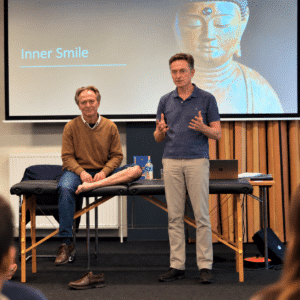
Engaging Vitality is based on several pillars including the classical medical acupuncture literature, osteopathic palpation techniques, and internal alchemy (Nei Dan). This approach was developed by Dan Bensky and Charles Chace, both prominent figures in acupuncture and Chinese herbal medicine. They are teachers and practitioners with extensive clinical experience combined with deep knowledge of classical Chinese medical texts.
Engaging Vitality is an approach to acupuncture that will greatly expand your range of diagnostic skills and treatment techniques. You will learn a range of palpation techniques derived from osteopathy and practices in East Asian Medicine. Your treatments will become a lot more efficient since you learn to identify the energetic and structural issues more clearly. On one hand, it is deeply rooted in classical tradition, while on the other, it is enhanced with new tools.
What is Engaging Vitality?
Engaging Vitality is an approach that can provide depth and breadth to anyone who has studied acupuncture. It emphasizes a hands-on practice, allowing the practitioner to quickly integrate the learned techniques into their own clinic. It is an approach not based on a fixed protocol like most acupuncture schools. This gives every practitioner the freedom to integrate the material in their own way.
Important aspects of Engaging Vitality include:
- Learning to directly feel the Qi through palpation. This is a diagnostic method you can use alongside the pulse, tongue observation, or hara (abdomen) palpation, etc. Information that you may miss through conventional methods can be obtained this way, making it an invaluable diagnostic tool. It also provides you with immediate feedback during treatment.
- Learning to feel different rhythms, which are derived from osteopathy but interpreted in the context of acupuncture. This gives you a more accurate picture of the various manifestations of Qi, such as Yang Qi, Yin Qi and the „Fluid body,“ etc. These rhythms can also help you determine where restrictions in the body are located. Other techniques you will learn, such as “global and local listening,“ can enable you to accurately pinpoint the location of restrictions. Resolving restrictions in the body is of vital importance, since opening those is a requisite for initiating the self-healing process in the body.
- You will also learn to integrate the biomedical anatomical map and the Chinese acupuncture map, allowing you to perceive restrictions in the system much more accurately.
- Learning to optimally use needling techniques. Unlike a more mechanical approach in modern acupuncture, Engaging Vitality places much emphasis on the technique of needling. There is attention to both the physical and mental posture during needling, making an acupuncture treatment significantly more effective. You will learn to achieve much more with fewer needles.
- Learning to use Manual Thermal Diagnostics (a technique originally developed by Jean Pierre Barral), enabling the practitioner to gather a lot of diagnostic information based on differences in heat sensation and/or air pressure. This can also assist in point location on the channels.
- An approach to the Extraordinary Vessels based on the interpretation of Li Shizhen, one of the greatest doctors in Chinese medicine. Here, knowledge from the acupuncture tradition is combined with the Nei Dan (internal alchemy) tradition, resulting in a much broader understanding of the Extraordinary Vessels, thereby significantly increasing therapeutic possibilities.
- Listening to the meridians; this technique teaches us how to determine whether a meridian is open or blocked, knowledge that is crucial in choosing which meridians to treat.
- Integration of all aspects of acupuncture such as the primary meridians, luo vessels, tendino-muscular meridians, divergent meridians, and the extraordinary vessels.